
-
×
 Trading Short TermSame Day Trades Sep 2023 with Dan Sheridan & Mark Fenton - Sheridan Options Mentoring
1 × $31.00
Trading Short TermSame Day Trades Sep 2023 with Dan Sheridan & Mark Fenton - Sheridan Options Mentoring
1 × $31.00 -
×
 TRADING NFX Course with Andrew NFX
1 × $5.00
TRADING NFX Course with Andrew NFX
1 × $5.00 -
×
 Compass Trading System with Right Line Trading
1 × $39.00
Compass Trading System with Right Line Trading
1 × $39.00 -
×
 The Orderflow Masterclass with PrimeTrading
1 × $17.00
The Orderflow Masterclass with PrimeTrading
1 × $17.00 -
×
 Essentials in Quantitative Trading QT01 By HangukQuant's
1 × $23.00
Essentials in Quantitative Trading QT01 By HangukQuant's
1 × $23.00 -
×
 0 DTE Options Trading Workshop with Aeromir Corporation
1 × $15.00
0 DTE Options Trading Workshop with Aeromir Corporation
1 × $15.00
3 Volatility Strategies with Quantified Strategies
Original price was: $349.00.$23.00Current price is: $23.00.
File Size: 5.01 MB
Delivery Time: 1–12 hours
Media Type: Online Course
Content Proof: Watch Here!
You may check content proof of “3 Volatility Strategies with Quantified Strategies” below:
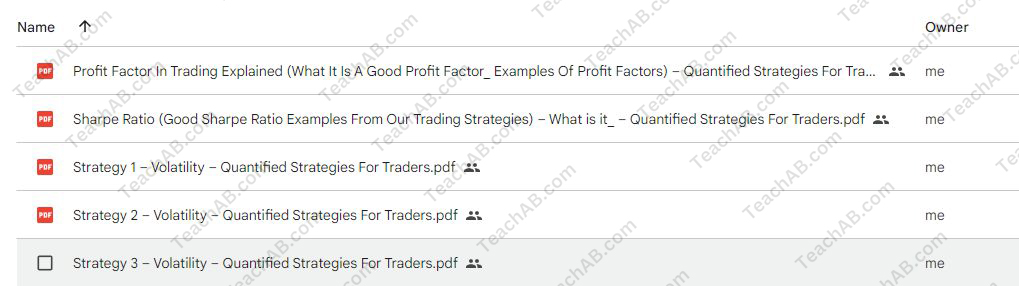
3 Volatility Strategies with Quantified Strategies
Introduction
In the dynamic world of trading, understanding and leveraging volatility can lead to significant gains. We explore three quantified strategies designed to help traders not just survive but thrive in volatile markets. Each strategy is backed by data-driven insights, providing a robust foundation for making informed trading decisions.
Understanding Market Volatility
Before diving into the strategies, it’s crucial to grasp what market volatility is and why it matters. Volatility refers to the rate at which the price of a security increases or decreases for a given set of returns. High volatility means that a security’s price can change dramatically over a short period in either direction, which can be both an opportunity and a risk.
Why Trade Volatility?
Trading volatility offers the potential for high returns, especially when markets are unpredictable. By mastering volatility trading strategies, we can capitalize on market inefficiencies.
Strategy 1: The Mean Reversion Setup
The mean reversion theory is based on the premise that prices and returns eventually move back towards the mean or average. This strategy is particularly effective in volatile markets.
How to Implement the Mean Reversion Strategy
- Identify Overextended Prices: Look for prices that have moved significantly away from their historical averages.
- Setup Entry and Exit Points: Use technical indicators to determine when to enter and exit trades.
- Risk Management: Set stop-loss orders to manage potential losses effectively.
Tools and Indicators
- Bollinger Bands
- Moving Average Convergence Divergence (MACD)
- Relative Strength Index (RSI)
Strategy 2: The Breakout Strategy
This strategy capitalizes on moments when the price breaks out from its existing range or pattern, often due to increased volatility.
Implementing the Breakout Strategy
- Identify Key Levels: Focus on levels of support and resistance.
- Wait for the Breakout: Enter the trade when the price moves beyond these levels.
- Follow Through: Ensure the breakout is supported by high volume, indicating strength.
Key Considerations
- False breakouts can occur, so it’s important to confirm breakouts with additional signals.
Strategy 3: The Momentum Ignition Strategy
Momentum ignition strategies aim to capitalize on the acceleration of an asset’s price movement in a particular direction.
Steps to Execute the Momentum Ignition Strategy
- Identify Momentum Build-Up: Look for signs that the price is about to make a big move.
- Entry Strategy: Enter the trade after confirming the momentum direction.
- Monitoring and Exit: Monitor the trade closely and exit at pre-defined profit targets.
Effective Tools for Momentum Trading
- Stochastic Oscillator
- Average Directional Index (ADI)
Integrating Advanced Technology
Leveraging advanced technology such as algorithmic trading can enhance the effectiveness of these strategies by increasing execution speed and minimizing errors.
Algorithmic Trading and Its Benefits
- Speed: Faster order execution.
- Precision: Accurate entry and exit points.
- Consistency: Reduces human emotional involvement.
Conclusion
Understanding and implementing these three volatility trading strategies can significantly enhance your trading performance. Whether it’s the mean reversion, the breakout strategy, or momentum ignition, each has its unique approach to capitalizing on market movements. With the right tools and a disciplined approach, these strategies offer a pathway to potential profitability in volatile markets.
FAQs
- What is market volatility? Market volatility refers to the fluctuation in the price of securities within a short period.
- Which volatility strategy is best for beginners? The mean reversion strategy is often recommended for beginners due to its straightforward approach.
- How important is risk management in volatility trading? Extremely important; it helps mitigate potential losses during unexpected market movements.
- Can these strategies be automated? Yes, all three strategies can be automated using algorithmic trading systems.
- How do I test these strategies without risking capital? Simulated trading or paper trading platforms allow for risk-free strategy testing.
Be the first to review “3 Volatility Strategies with Quantified Strategies”
You must be logged in to post a review.
Related products

Forex Trading
The Complete Guide to Multiple Time Frame Analysis & Reading Price Action with Aiman Almansoori
Original price was: $1,399.00.$13.00Current price is: $13.00.

Forex Trading
Original price was: $499.00.$15.00Current price is: $15.00.

Original price was: $497.00.$31.00Current price is: $31.00.

Original price was: $450.00.$23.00Current price is: $23.00.

Forex Trading
Original price was: $797.00.$10.00Current price is: $10.00.

Original price was: $695.00.$41.00Current price is: $41.00.
Forex Trading
Original price was: $500.00.$5.00Current price is: $5.00.

Original price was: $1,800.00.$54.00Current price is: $54.00.

Forex Trading
Original price was: $4,997.00.$27.00Current price is: $27.00.

Original price was: $4,995.00.$15.00Current price is: $15.00.

Forex Trading
Original price was: $2,997.00.$23.00Current price is: $23.00.

Original price was: $649.00.$20.00Current price is: $20.00.

Forex Trading
Original price was: $550.00.$5.00Current price is: $5.00.

Original price was: $2,120.00.$15.00Current price is: $15.00.

Original price was: $999.00.$5.00Current price is: $5.00.

Original price was: $997.00.$13.00Current price is: $13.00.

Forex Trading
Original price was: $249.00.$15.00Current price is: $15.00.
Forex Trading
Original price was: $999.00.$15.00Current price is: $15.00.

Original price was: $310.00.$23.00Current price is: $23.00.

Original price was: $497.00.$11.00Current price is: $11.00.
Reviews
There are no reviews yet.