
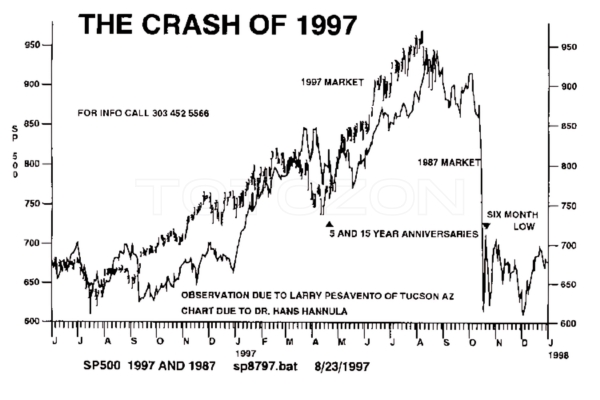
The Crash of 1997 (Article) with Hans Hannula
$6.00
File Size: Coming soon!
Delivery Time: 1–12 hours
Media Type: Online Course
Content Proof: Watch Here!
You may check content proof of “The Crash of 1997 (Article) with Hans Hannula” below:

The Crash of 1997 Analyzed by Hans Hannula
Introduction
In 1997, financial markets around the globe experienced a seismic shock known as the Asian Financial Crisis. Hans Hannula, with his unique perspective on market dynamics through the lens of astrophysics, provides intriguing insights into this tumultuous period. Let’s explore the crash of 1997 and unravel its mysteries with the guidance of Hannula’s astrophysical analysis.
Understanding the Crash of 1997
Overview of the Crisis
The crash, initially triggered in Thailand with the collapse of the Thai baht, quickly rippled across Asia and impacted global markets. This section delves into the sequence of events that led to a widespread financial contagion.
Key Factors Leading to the Crisis
Several factors, including high debt levels, speculative investments, and fixed exchange rate policies, compounded to precipitate the crash. We’ll examine each component to understand their contributory roles.
Hans Hannula’s Perspective
Astrophysical Influences on Markets
Hannula suggests that celestial alignments can influence market sentiments and decisions. During 1997, significant planetary positions might have exacerbated market volatility.
Predictive Analysis through Market Astrophysics
How might Hannula’s method of Market Astrophysics have predicted the crash? This section explores the predictive potential of astrophysical data on market movements.
Timeline of the Crash
Initial Triggers
We’ll outline the key events starting from Thailand’s financial turmoil to its rapid spread to neighboring economies like Indonesia and South Korea.
Global Impact
The reverberations of the crisis were felt worldwide, affecting markets in the West and altering economic policies globally.
The Role of Government and Financial Institutions
Policy Responses
How did governments respond to stem the crisis? We discuss the measures taken by affected countries to stabilize their economies.
Long-Term Reforms
The crash led to significant financial reforms aimed at preventing a recurrence. We’ll review these changes and assess their effectiveness.
Economic Theories and Market Behavior
Traditional vs. Astrophysical Theories
Comparing traditional economic theories with Hannula’s astrophysical approach provides a broader understanding of market dynamics.
Behavioral Finance Insights
How did investor psychology contribute to the crisis? This section applies behavioral finance principles to explain the irrational behaviors that intensified the crash.
Learning from the Past
Lessons for Modern Traders
What can today’s investors learn from the crash of 1997? Insights from Hannula’s work highlight the importance of considering broader, unconventional data sets.
Astrophysical Strategies in Modern Trading
Implementing astrophysical strategies in today’s trading environment could offer a novel approach to forecasting and risk management.
Conclusion
Reflecting on the crash of 1997 through Hans Hannula’s astrophysical lens offers a unique perspective on the interconnectivity of celestial events and market dynamics. Whether one subscribes to traditional economic theories or the innovative field of Market Astrophysics, the lessons from this period remain invaluable for navigating future market uncertainties.
FAQs
What triggered the Crash of 1997?
The crisis began in Thailand with the collapse of the Thai baht due to speculative attacks and financial imbalances.
How did Hans Hannula’s approach analyze the crash?
Hannula used astrophysical data to understand market sentiments and potential triggers of volatility.
Can Market Astrophysics predict future financial crises?
While not foolproof, Market Astrophysics can offer unique insights into potential market stress points influenced by celestial alignments.
What were some key global impacts of the crash?
The crash affected global stock markets, led to increased financial scrutiny, and prompted economic reforms worldwide.
How relevant is Market Astrophysics in today’s trading?
With advancements in technology and greater data availability, Market Astrophysics is gaining traction among traders looking for an edge in predictive analytics.
Be the first to review “The Crash of 1997 (Article) with Hans Hannula”
You must be logged in to post a review.
Related products







Forex Trading




Forex Trading

Forex Trading



Forex Trading
Quantamentals – The Next Great Forefront Of Trading and Investing with Trading Markets



Forex Trading


Reviews
There are no reviews yet.