
-
×
 Quantamentals - The Next Great Forefront Of Trading and Investing with Trading Markets
1 × $8.00
Quantamentals - The Next Great Forefront Of Trading and Investing with Trading Markets
1 × $8.00 -
×
 High Probability Trading Using Elliott Wave And Fibonacci Analysis withVic Patel - Forex Training Group
1 × $10.00
High Probability Trading Using Elliott Wave And Fibonacci Analysis withVic Patel - Forex Training Group
1 × $10.00 -
×
 0 DTE Options Trading Workshop with Aeromir Corporation
1 × $15.00
0 DTE Options Trading Workshop with Aeromir Corporation
1 × $15.00 -
×
 Deep Dive Butterfly Trading Strategy Class with SJG Trades
1 × $41.00
Deep Dive Butterfly Trading Strategy Class with SJG Trades
1 × $41.00 -
×
 AI For Traders with Trading Markets
1 × $31.00
AI For Traders with Trading Markets
1 × $31.00 -
×
 W. D Gann 's Square Of 9 Applied To Modern Markets with Sean Avidar - Hexatrade350
1 × $23.00
W. D Gann 's Square Of 9 Applied To Modern Markets with Sean Avidar - Hexatrade350
1 × $23.00 -
×
 Advanced Spread Trading with Guy Bower - MasterClass Trader
1 × $15.00
Advanced Spread Trading with Guy Bower - MasterClass Trader
1 × $15.00 -
×
 Scalp Strategy and Flipping Small Accounts with Opes Trading Group
1 × $5.00
Scalp Strategy and Flipping Small Accounts with Opes Trading Group
1 × $5.00 -
×
 Matrix Spread Options Trading Course with Base Camp Trading
1 × $31.00
Matrix Spread Options Trading Course with Base Camp Trading
1 × $31.00 -
×
 Crystal Ball Pack PLUS bonus Live Trade By Pat Mitchell - Trick Trades
1 × $20.00
Crystal Ball Pack PLUS bonus Live Trade By Pat Mitchell - Trick Trades
1 × $20.00 -
×
 How To Read The Market Professionally with TradeSmart
1 × $27.00
How To Read The Market Professionally with TradeSmart
1 × $27.00 -
×
 Essentials in Quantitative Trading QT01 By HangukQuant's
1 × $23.00
Essentials in Quantitative Trading QT01 By HangukQuant's
1 × $23.00 -
×
 The Naked Eye: Raw Data Analytics with Edgar Torres - Raw Data Analytics
1 × $8.00
The Naked Eye: Raw Data Analytics with Edgar Torres - Raw Data Analytics
1 × $8.00 -
×
 Home Run Options Trading Course with Dave Aquino - Base Camp Trading
1 × $11.00
Home Run Options Trading Course with Dave Aquino - Base Camp Trading
1 × $11.00
The Psychology Of Trading with Brett N.Steenbarger
$6.00
File Size: Coming soon!
Delivery Time: 1–12 hours
Media Type: Online Course
Content Proof: Watch Here!
You may check content proof of “The Psychology Of Trading with Brett N.Steenbarger” below:
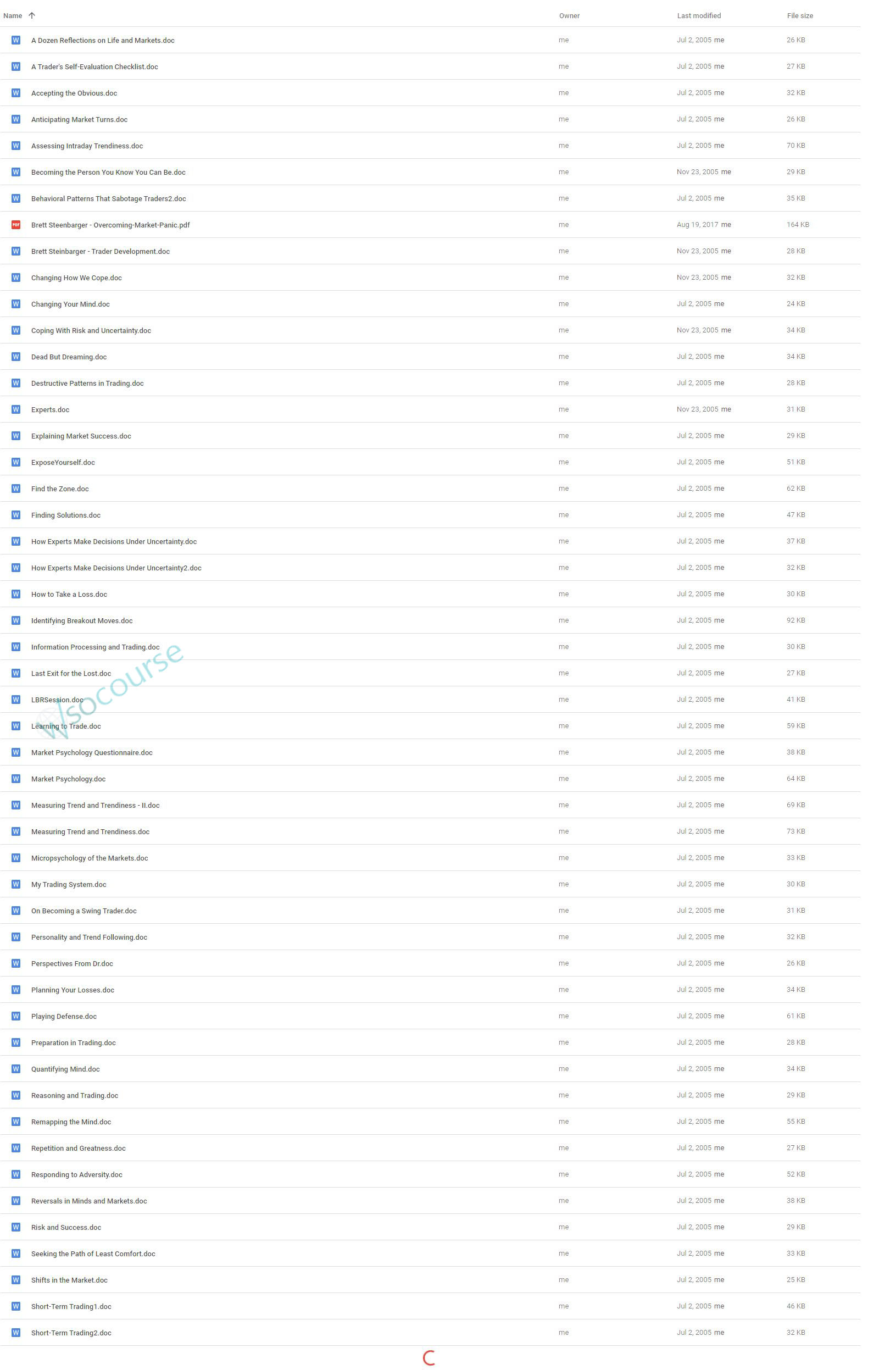
The Psychology of Trading with Brett N. Steenbarger
Introduction
In the high-stakes world of trading, success is not just about financial acumen but also psychological resilience. Brett N. Steenbarger, a revered figure in trading psychology, has illuminated the path for many traders. In this article, we delve into his teachings to understand how psychological factors influence trading performance.
Understanding Trading Psychology
What is Trading Psychology?
At its core, trading psychology is about the study of a trader’s behavior and mindset during the decision-making process in financial markets.
The Role of Emotions in Trading
Emotions can cloud judgment, leading to impulsive decisions that diverge from a well-planned trading strategy.
Steenbarger’s Key Psychological Insights
Cognitive Biases and Trading
Recognize and mitigate common cognitive biases like overconfidence and confirmation bias, which can distort trading decisions.
Emotional Regulation
Learn techniques to manage emotions, ensuring they don’t lead to costly trading mistakes.
Developing a Trader’s Mindset
The Importance of Self-Awareness
Self-awareness helps traders understand their natural predispositions and how these affect their trading.
Building Resilience
Resilience enables traders to endure the psychological stresses of market volatility.
Tools and Techniques for Enhancing Trading Psychology
Journaling for Improvement
Documenting trading activities can help identify emotional triggers and improve future decision-making.
Mindfulness and Meditation
These practices enhance concentration and emotional stability, reducing the risk of impulsive trading.
Applying Behavioral Finance
Understanding Market Psychology
Learn how mass psychology influences market movements and how to position oneself accordingly.
Behavioral Analysis in Trading
Apply behavioral finance theories to predict market trends and improve trading strategies.
Strategies to Combat Psychological Traps
Avoiding Overtrading
Recognize the psychological patterns that lead to overtrading and implement checks to prevent it.
Dealing with Loss Aversion
Understand the tendency to fear losses more than valuing gains and how to manage this bias.
Routine and Discipline in Trading
The Power of a Trading Routine
Establishing a consistent routine reduces uncertainty and emotional stress.
Discipline Over Impulse
Learn to prioritize long-term strategy over short-term emotional reactions.
Advanced Psychological Strategies
Psychological Flexibility
Adapting psychological strategies based on market conditions can enhance trading efficacy.
The Role of Confidence
Balancing confidence with humility prevents arrogance from leading to risky trading decisions.
Leveraging Technology in Trading Psychology
Using AI and Analytics
Incorporate advanced analytics and AI to understand psychological patterns and improve trading decisions.
Feedback Systems
Implement systems that provide real-time feedback on trading habits and emotional responses.
The Future of Trading Psychology
Continued Education
Keep abreast of the latest research in trading psychology to remain competitive.
Global Perspective
Understand how cultural differences influence trading behavior across global markets.
Conclusion
Trading psychology, as expounded by Brett N. Steenbarger, provides invaluable insights into the mental and emotional aspects of trading. By mastering these psychological concepts, traders can significantly enhance their decision-making process and overall trading performance.
Frequently Asked Questions
- What is the first step in applying trading psychology?
- The first step is gaining self-awareness of one’s emotions and behavioral patterns in trading scenarios.
- How does trading psychology differ from general psychology?
- Trading psychology specifically focuses on understanding and improving the psychological factors that affect decision-making in financial markets.
- Can trading psychology be used in all types of trading?
- Yes, trading psychology principles are applicable across different trading platforms, including stocks, forex, and commodities.
- What is the most common psychological trap for new traders?
- The most common trap is emotional trading, where decisions are made based on feelings rather than data.
- How often should a trader practice mindfulness?
- Regular practice, such as daily meditation, can help maintain psychological balance and improve trading performance.
Be the first to review “The Psychology Of Trading with Brett N.Steenbarger”
You must be logged in to post a review.
Related products

Forex Trading
Original price was: $125.00.$17.00Current price is: $17.00.

Original price was: $450.00.$23.00Current price is: $23.00.

Forex Trading
Original price was: $249.00.$15.00Current price is: $15.00.
Forex Trading
Original price was: $4,997.00.$27.00Current price is: $27.00.

Original price was: $299.00.$8.00Current price is: $8.00.

Forex Trading
Original price was: $2,000.00.$23.00Current price is: $23.00.
Original price was: $695.00.$41.00Current price is: $41.00.
Original price was: $895.00.$15.00Current price is: $15.00.
Forex Trading
Quantamentals – The Next Great Forefront Of Trading and Investing with Trading Markets
Original price was: $1,495.00.$8.00Current price is: $8.00.

Forex Trading
Original price was: $2,997.00.$23.00Current price is: $23.00.

Original price was: $310.00.$23.00Current price is: $23.00.

Forex Trading
Original price was: $799.00.$15.00Current price is: $15.00.
Original price was: $997.00.$8.00Current price is: $8.00.

Forex Trading
Original price was: $1,898.00.$10.00Current price is: $10.00.

Original price was: $4,995.00.$15.00Current price is: $15.00.
Forex Trading
Original price was: $999.00.$15.00Current price is: $15.00.

Forex Trading
Original price was: $697.00.$5.00Current price is: $5.00.

Forex Trading
The Complete Guide to Multiple Time Frame Analysis & Reading Price Action with Aiman Almansoori
Original price was: $1,399.00.$13.00Current price is: $13.00.

Forex Trading
Original price was: $499.00.$15.00Current price is: $15.00.

Original price was: $197.00.$5.00Current price is: $5.00.
Reviews
There are no reviews yet.