
-
×
 Order flow self-study training program with iMFtracker
1 × $10.00
Order flow self-study training program with iMFtracker
1 × $10.00 -
×
 The Best Option Trading Course with David Jaffee - Best Stock Strategy
1 × $15.00
The Best Option Trading Course with David Jaffee - Best Stock Strategy
1 × $15.00 -
×
 Advanced Group Analysis Turorial with David Vomund
1 × $6.00
Advanced Group Analysis Turorial with David Vomund
1 × $6.00 -
×
 Volume Profile 2023 (Elite Pack) with Trader Dale
1 × $5.00
Volume Profile 2023 (Elite Pack) with Trader Dale
1 × $5.00 -
×
 The Master Indicator 2023 with Lance Ippolito
1 × $101.00
The Master Indicator 2023 with Lance Ippolito
1 × $101.00 -
×
 Adx Mastery Complete Course
1 × $6.00
Adx Mastery Complete Course
1 × $6.00 -
×
 The Candlestick Training Series with Timon Weller
1 × $6.00
The Candlestick Training Series with Timon Weller
1 × $6.00 -
×
 W. D Gann 's Square Of 9 Applied To Modern Markets with Sean Avidar - Hexatrade350
1 × $23.00
W. D Gann 's Square Of 9 Applied To Modern Markets with Sean Avidar - Hexatrade350
1 × $23.00 -
×
 A Mathematician Plays The Stock Market with John Allen Paulos
1 × $6.00
A Mathematician Plays The Stock Market with John Allen Paulos
1 × $6.00 -
×
 Inefficient Markets with Andrei Shleifer
1 × $6.00
Inefficient Markets with Andrei Shleifer
1 × $6.00 -
×
 How Do You Read Charts? A Guide to Classic Price Pattern Recognition Class with Professor Jeff Bierman
1 × $6.00
How Do You Read Charts? A Guide to Classic Price Pattern Recognition Class with Professor Jeff Bierman
1 × $6.00 -
×
 Ultimate Trading Course with Dodgy's Dungeon
1 × $8.00
Ultimate Trading Course with Dodgy's Dungeon
1 × $8.00 -
×
 $20 – 52k 20 pips a day challange with Rafał Zuchowicz - TopMasterTrader
1 × $5.00
$20 – 52k 20 pips a day challange with Rafał Zuchowicz - TopMasterTrader
1 × $5.00 -
×
 A Game Plan for Investing in the 21st Century with Thomas J.Dorsey
1 × $6.00
A Game Plan for Investing in the 21st Century with Thomas J.Dorsey
1 × $6.00 -
×
 Advanced Iron Condor Course in 2021
1 × $6.00
Advanced Iron Condor Course in 2021
1 × $6.00 -
×
 Advanced Trading Course with DovyFX
1 × $5.00
Advanced Trading Course with DovyFX
1 × $5.00 -
×
 A Working Man's Forex Position Trading System 2010 with Alan Benefield
1 × $6.00
A Working Man's Forex Position Trading System 2010 with Alan Benefield
1 × $6.00 -
×
 Compass Trading System with Right Line Trading
1 × $39.00
Compass Trading System with Right Line Trading
1 × $39.00 -
×
 Trading Short TermSame Day Trades Sep 2023 with Dan Sheridan & Mark Fenton - Sheridan Options Mentoring
1 × $31.00
Trading Short TermSame Day Trades Sep 2023 with Dan Sheridan & Mark Fenton - Sheridan Options Mentoring
1 × $31.00 -
×
 White Phoenix’s The Smart (Money) Approach to Trading with Jayson Casper
1 × $39.00
White Phoenix’s The Smart (Money) Approach to Trading with Jayson Casper
1 × $39.00 -
×
 Advanced Option Trading with Broken Wing Butterflys with Greg Loehr
1 × $9.00
Advanced Option Trading with Broken Wing Butterflys with Greg Loehr
1 × $9.00 -
×
 Empirical Market Microstructure
1 × $6.00
Empirical Market Microstructure
1 × $6.00 -
×
 WondaFX Signature Strategy with WondaFX
1 × $5.00
WondaFX Signature Strategy with WondaFX
1 × $5.00 -
×
 High Probability Trading Using Elliott Wave And Fibonacci Analysis withVic Patel - Forex Training Group
1 × $10.00
High Probability Trading Using Elliott Wave And Fibonacci Analysis withVic Patel - Forex Training Group
1 × $10.00 -
×
 ICT Prodigy Trading Course – $650K in Payouts with Alex Solignani
1 × $15.00
ICT Prodigy Trading Course – $650K in Payouts with Alex Solignani
1 × $15.00
Pattern Recognition: A Fundamental Introduction to Japanese Candlestick Charting Techniques Class with Jeff Bierman
Original price was: $95.00.$6.00Current price is: $6.00.
File Size: 878 MB
Delivery Time: 1–12 hours
Media Type: Online Course
Content Proof: Watch Here!
You may check content proof of “Pattern Recognition: A Fundamental Introduction to Japanese Candlestick Charting Techniques Class with Jeff Bierman” below:
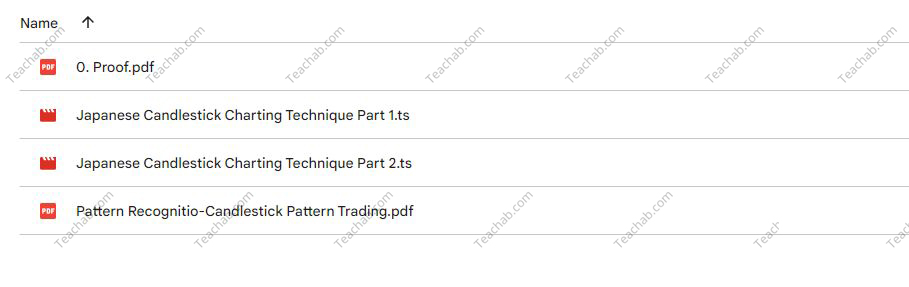
Pattern Recognition: A Fundamental Introduction to Japanese Candlestick Charting Techniques Class with Jeff Bierman
Introduction
Understanding the nuances of Japanese Candlestick charting is essential for any trader looking to gain deeper insights into market psychology and price movements. Jeff Bierman, an expert in technical analysis, provides a thorough introduction to this powerful charting technique that has stood the test of time. Let’s explore the foundational elements of candlestick charting and how it can be applied to enhance trading strategies.
What Are Japanese Candlesticks?
The Origin of Candlestick Charting
Originally developed in Japan over 300 years ago for rice trading, candlestick patterns have evolved into a crucial tool in the technical analyst’s toolkit, offering detailed information about market sentiment and potential price movements.
Understanding the Candlestick Structure
- The Body: Shows the open and close price.
- The Wicks: Indicate the high and low.
Color Significance in Candlesticks
- Green/White: Indicates a price increase.
- Red/Black: Indicates a price decrease.
Basic Candlestick Patterns
Single Candlestick Patterns
- Doji: Represents indecision in the market.
- Hammer: Suggests a potential bullish reversal.
- Shooting Star: Points to a potential bearish reversal.
Why Single Patterns Matter
These patterns provide immediate insights into daily market movements, offering clues about potential reversals or continuations.
Complex Candlestick Patterns
Multiple Candlestick Patterns
- Bullish Engulfing: Can signal a reversal from bearish to bullish.
- Bearish Engulfing: Might indicate a shift from bullish to bearish.
- Morning Star: A three-candle pattern suggesting a bullish reversal.
Understanding Pattern Combinations
Multiple patterns can provide a clearer picture of market trends and help traders make more informed decisions.
The Psychology Behind Candlestick Patterns
Market Emotions and Candlesticks
Candlestick patterns are deeply tied to investor psychology, reflecting the tug-of-war between buyers and sellers.
Interpreting Emotional Cues
Patterns like the Doji or Engulfing setups can indicate shifts in market sentiment that are crucial for anticipating future movements.
Integrating Candlesticks with Other Technical Tools
Combining Candlesticks with Technical Indicators
- RSI
- MACD
- Moving Averages
These tools can help confirm the signals provided by candlestick patterns, leading to more robust trading strategies.
Practical Application of Candlestick Techniques
Real-World Trading Scenarios
Professor Bierman emphasizes practical application through real-world examples, demonstrating how these patterns play out in live markets.
How to Practice Candlestick Analysis
- Simulated trading sessions.
- Historical chart analysis.
Advanced Techniques and Strategies
Beyond the Basics
Exploring the nuances of complex patterns and how they can predict market movements.
Strategic Integration
How to blend candlestick analysis with overall trading strategies for optimal performance.
Conclusion
Japanese candlestick charting techniques offer a dynamic and insightful way to view market trends. With Professor Jeff Bierman’s guidance, traders can master these techniques, enriching their trading toolkit and enhancing their decision-making processes.
FAQs
1. Why are Japanese candlesticks popular among traders?
They provide a visually intuitive method of understanding market dynamics and trader sentiment.
2. Can candlestick patterns be used for all types of trading?
Yes, candlestick patterns are versatile and can be applied across different markets, including forex, stocks, and commodities.
3. How reliable are candlestick patterns in predicting market movements?
While not foolproof, when combined with other technical analysis tools, candlestick patterns can significantly enhance prediction accuracy.
4. What should a beginner focus on when learning candlesticks?
Beginners should start with basic patterns and gradually explore more complex formations.
5. How does Jeff Bierman suggest traders refine their candlestick charting skills?
Through continuous practice and review of historical data to recognize patterns and their outcomes.
Be the first to review “Pattern Recognition: A Fundamental Introduction to Japanese Candlestick Charting Techniques Class with Jeff Bierman”
You must be logged in to post a review.
Related products

Forex Trading
Original price was: $125.00.$17.00Current price is: $17.00.

Forex Trading
Original price was: $799.00.$15.00Current price is: $15.00.
Original price was: $700.00.$39.00Current price is: $39.00.
Forex Trading
Original price was: $239.00.$8.00Current price is: $8.00.

Original price was: $299.00.$8.00Current price is: $8.00.

Forex Trading
Original price was: $697.00.$5.00Current price is: $5.00.

Forex Trading
Original price was: $500.00.$5.00Current price is: $5.00.

Forex Trading
Original price was: $2,997.00.$23.00Current price is: $23.00.
Forex Trading
Original price was: $550.00.$5.00Current price is: $5.00.

Original price was: $450.00.$23.00Current price is: $23.00.
Forex Trading
Original price was: $797.00.$10.00Current price is: $10.00.

Forex Trading
Quantamentals – The Next Great Forefront Of Trading and Investing with Trading Markets
Original price was: $1,495.00.$8.00Current price is: $8.00.

Forex Trading
Original price was: $4,997.00.$27.00Current price is: $27.00.

Forex Trading
Original price was: $249.00.$15.00Current price is: $15.00.

Forex Trading
Original price was: $850.00.$23.00Current price is: $23.00.
Original price was: $1,849.00.$15.00Current price is: $15.00.
Original price was: $2,120.00.$15.00Current price is: $15.00.

Original price was: $997.00.$13.00Current price is: $13.00.

Original price was: $497.00.$11.00Current price is: $11.00.
Forex Trading
Original price was: $397.00.$31.00Current price is: $31.00.

Reviews
There are no reviews yet.