
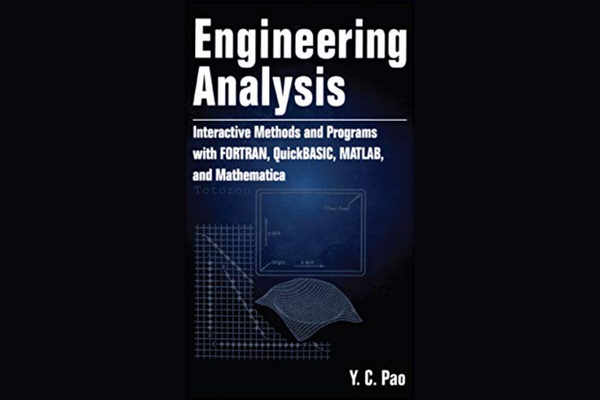
Engineering Analysis: Interactive Methods and Programs with FORTRAN, QuickBASIC, MATLAB, and Mathematica with Yen-Ching Pao
Original price was: $194.00.$6.00Current price is: $6.00.
File Size: Coming soon!
Delivery Time: 1–12 hours
Media Type: Online Course
Content Proof: Watch Here!
You may check content proof of “Engineering Analysis: Interactive Methods and Programs with FORTRAN, QuickBASIC, MATLAB, and Mathematica with Yen-Ching Pao” below:
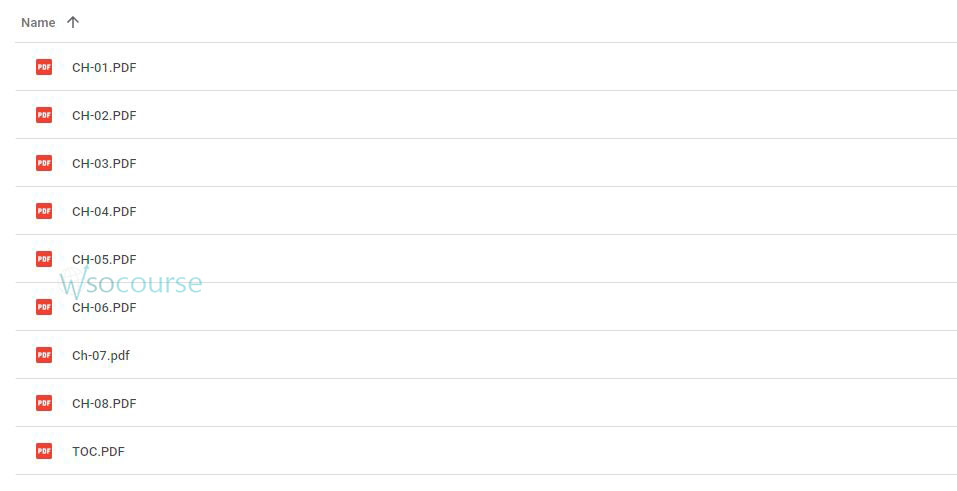
Engineering Analysis: Interactive Methods and Programs with FORTRAN, QuickBASIC, MATLAB, and Mathematica By Yen-Ching Pao
In the realm of engineering analysis, the integration of interactive methods and diverse programming languages is pivotal. Yen-Ching Pao’s work, “Engineering Analysis: Interactive Methods and Programs with FORTRAN, QuickBASIC, MATLAB, and Mathematica,” serves as a comprehensive guide for engineers and students. This article will delve into the methodologies and applications presented in Pao’s book, emphasizing the unique contributions of each programming language.
Introduction to Engineering Analysis
Engineering analysis involves using mathematical and computational techniques to solve complex engineering problems. Pao’s approach integrates multiple programming languages to enhance the interactive capabilities and efficiency of engineering computations.
Who is Yen-Ching Pao?
Yen-Ching Pao is a distinguished engineer and author, known for his contributions to computational methods in engineering. His expertise spans various programming languages and their applications in solving engineering problems.
Interactive Methods in Engineering
What are Interactive Methods?
Interactive methods refer to techniques that allow real-time interaction between the user and the computational process. This approach enhances the efficiency and accuracy of engineering analyses.
Advantages of Interactive Methods
- Real-Time Feedback: Immediate results and corrections.
- Enhanced Accuracy: Reduced errors through continuous interaction.
- Improved Understanding: Better grasp of the problem through interactive exploration.
Applications in Engineering
Interactive methods are applied in various engineering fields, including structural analysis, fluid dynamics, and thermal engineering. These methods facilitate the modeling, simulation, and optimization of engineering systems.
Programming Languages in Pao’s Work
FORTRAN
FORTRAN, one of the oldest high-level programming languages, is renowned for its efficiency in numerical and scientific computing.
Key Features of FORTRAN
- Efficiency: High-performance computations.
- Portability: Widely used in scientific applications.
- Robust Libraries: Extensive libraries for mathematical functions.
QuickBASIC
QuickBASIC, developed by Microsoft, is a user-friendly language that offers an interactive environment for beginners and advanced users alike.
Key Features of QuickBASIC
- Ease of Use: Simple syntax and interactive development.
- Versatility: Suitable for various applications, from educational tools to professional engineering software.
- Rapid Prototyping: Quick development and testing of algorithms.
MATLAB
MATLAB is a high-level language and interactive environment for numerical computation, visualization, and programming.
Key Features of MATLAB
- Powerful Toolboxes: Specialized toolboxes for different engineering fields.
- Visualization: Advanced plotting and visualization capabilities.
- Ease of Use: Intuitive syntax and extensive documentation.
Mathematica
Mathematica is a computational software system used for symbolic and numerical calculations.
Key Features of Mathematica
- Symbolic Computation: Advanced algebraic manipulations.
- Interactive Notebooks: Dynamic documents for calculations and visualizations.
- Integration: Seamless integration with other programming languages and tools.
Implementing Interactive Methods
Combining Programming Languages
Pao’s approach emphasizes the integration of multiple programming languages to leverage their unique strengths.
Example Applications
- Structural Analysis: Using FORTRAN for high-performance computations, MATLAB for visualization, and Mathematica for symbolic calculations.
- Fluid Dynamics: QuickBASIC for initial prototyping and MATLAB for detailed simulations and analysis.
Step-by-Step Implementation
- Define the Problem: Clearly outline the engineering problem to be solved.
- Select Appropriate Tools: Choose the programming languages and tools based on the problem requirements.
- Develop Algorithms: Write and test algorithms using the selected languages.
- Integrate and Interact: Combine the outputs and interactively refine the solutions.
Case Studies
Structural Engineering Analysis
Using Pao’s methods, a structural engineer might use FORTRAN to perform detailed numerical simulations, MATLAB to visualize stress distributions, and Mathematica to optimize the design parameters.
Thermal Analysis
In thermal engineering, QuickBASIC can be used for initial heat transfer calculations, while MATLAB and Mathematica can handle complex simulations and symbolic manipulations, respectively.
Advantages of Pao’s Approach
Comprehensive Analysis
By integrating multiple programming languages, Pao’s approach allows for a more thorough analysis of engineering problems, combining numerical, symbolic, and visual methods.
Flexibility and Adaptability
This method is adaptable to various engineering fields and problem types, making it a versatile tool for engineers.
Efficiency and Accuracy
Interactive methods enhance both the efficiency and accuracy of computations, leading to better engineering solutions.
Challenges and Considerations
Learning Curve
Mastering multiple programming languages and their integration requires time and effort.
Software Compatibility
Ensuring compatibility between different software tools can be challenging but is essential for seamless integration.
Conclusion
Yen-Ching Pao’s “Engineering Analysis: Interactive Methods and Programs with FORTRAN, QuickBASIC, MATLAB, and Mathematica” offers a robust framework for solving complex engineering problems. By leveraging the strengths of multiple programming languages and interactive methods, engineers can achieve more accurate and efficient solutions. Embrace Pao’s methodologies to enhance your engineering analysis and computational skills.
FAQs
What is the focus of Yen-Ching Pao’s book?
Pao’s book focuses on integrating interactive methods and multiple programming languages to solve engineering problems efficiently.
Which programming languages are covered in the book?
The book covers FORTRAN, QuickBASIC, MATLAB, and Mathematica, highlighting their applications in engineering analysis.
How do interactive methods benefit engineering analysis?
Interactive methods provide real-time feedback, enhance accuracy, and improve understanding of complex engineering problems.
Can these methods be applied to all engineering fields?
Yes, Pao’s methods are adaptable to various engineering fields, including structural, thermal, and fluid dynamics.
What are the challenges of implementing these methods?
Challenges include mastering multiple programming languages and ensuring software compatibility for seamless integration.
Be the first to review “Engineering Analysis: Interactive Methods and Programs with FORTRAN, QuickBASIC, MATLAB, and Mathematica with Yen-Ching Pao”
You must be logged in to post a review.
Related products

Forex Trading




Forex Trading

Forex Trading

Forex Trading

Forex Trading

Forex Trading




Forex Trading

Forex Trading

Forex Trading



Forex Trading

Forex Trading


Reviews
There are no reviews yet.