
-
×
 Market Risk Analysis, Volume III, Pricing, Hedging and Trading Financial Instruments with Carol Alexander
1 × $6.00
Market Risk Analysis, Volume III, Pricing, Hedging and Trading Financial Instruments with Carol Alexander
1 × $6.00 -
×
 Candlestick Secrets For Profiting In Options
1 × $23.00
Candlestick Secrets For Profiting In Options
1 × $23.00 -
×
 Market Risk Analysis, Volume IV, Value at Risk Models with Carol Alexander
1 × $6.00
Market Risk Analysis, Volume IV, Value at Risk Models with Carol Alexander
1 × $6.00 -
×
 Algo Trading Strategies 2017 with Autotrading Academy
1 × $6.00
Algo Trading Strategies 2017 with Autotrading Academy
1 × $6.00 -
×
 Unsorted Articles about the Psychology of Trading with Brett N.Steenbarger
1 × $6.00
Unsorted Articles about the Psychology of Trading with Brett N.Steenbarger
1 × $6.00 -
×
 Outsmarting the Smart Money with Lawrence A.Cunningham
1 × $6.00
Outsmarting the Smart Money with Lawrence A.Cunningham
1 × $6.00 -
×
 Commodity Trading Video Course with Bob Buran
1 × $6.00
Commodity Trading Video Course with Bob Buran
1 × $6.00 -
×
 Home Run Options Trading Course with Dave Aquino - Base Camp Trading
1 × $11.00
Home Run Options Trading Course with Dave Aquino - Base Camp Trading
1 × $11.00 -
×
 Chart Reading Course with TraderSumo
1 × $5.00
Chart Reading Course with TraderSumo
1 × $5.00 -
×
 NQ Price Action Mastery with Trade Smart
1 × $15.00
NQ Price Action Mastery with Trade Smart
1 × $15.00 -
×
 Cycles: What they are, what they mean, how to profit by them - Dick Stoken
1 × $6.00
Cycles: What they are, what they mean, how to profit by them - Dick Stoken
1 × $6.00 -
×
 A Day In The Life Of A Forex Trader with Vic Noble & Shirley Hudson
1 × $23.00
A Day In The Life Of A Forex Trader with Vic Noble & Shirley Hudson
1 × $23.00 -
×
 Trading Ist Ein Geschaft (German) (tradingeducators.com)
1 × $6.00
Trading Ist Ein Geschaft (German) (tradingeducators.com)
1 × $6.00 -
×
 The Risk-Wise Investor: How to Better Understand and Manage Risk with Michael Carpenter
1 × $6.00
The Risk-Wise Investor: How to Better Understand and Manage Risk with Michael Carpenter
1 × $6.00 -
×
 CMT Association Entire Webinars
1 × $31.00
CMT Association Entire Webinars
1 × $31.00 -
×
 Algohub 2023 Full Completed with Algohub
1 × $5.00
Algohub 2023 Full Completed with Algohub
1 × $5.00 -
×
 Power Cycle Trading The Ultimate Option Guide: When & How to Use Which Option Strategy For the Best Results - Powercycletrading
1 × $69.00
Power Cycle Trading The Ultimate Option Guide: When & How to Use Which Option Strategy For the Best Results - Powercycletrading
1 × $69.00 -
×
 Emini Day Trading Boot Camp - Base Camp Trading
1 × $6.00
Emini Day Trading Boot Camp - Base Camp Trading
1 × $6.00 -
×
 The EAP Training Program (Apr 2019)
1 × $6.00
The EAP Training Program (Apr 2019)
1 × $6.00 -
×
 Trading with Wave59 with Earik Beann
1 × $6.00
Trading with Wave59 with Earik Beann
1 × $6.00 -
×
 Momentum Options Trading Course with Eric Jellerson
1 × $272.00
Momentum Options Trading Course with Eric Jellerson
1 × $272.00 -
×
 Algorithmic Rules of Trend Lines
1 × $23.00
Algorithmic Rules of Trend Lines
1 × $23.00 -
×
 Cheat Code Trading System
1 × $13.00
Cheat Code Trading System
1 × $13.00 -
×
 Debt Capital Markets in China with Jian Gao
1 × $6.00
Debt Capital Markets in China with Jian Gao
1 × $6.00 -
×
 The Complete Guide to Multiple Time Frame Analysis & Reading Price Action with Aiman Almansoori
1 × $13.00
The Complete Guide to Multiple Time Frame Analysis & Reading Price Action with Aiman Almansoori
1 × $13.00 -
×
 Crystal Ball Pack PLUS bonus Live Trade By Pat Mitchell - Trick Trades
1 × $20.00
Crystal Ball Pack PLUS bonus Live Trade By Pat Mitchell - Trick Trades
1 × $20.00

Monthly Newsletter 99-01 with Elliott Wave Theorist
$6.00
File Size: Coming soon!
Delivery Time: 1–12 hours
Media Type: Online Course
Content Proof: Watch Here!
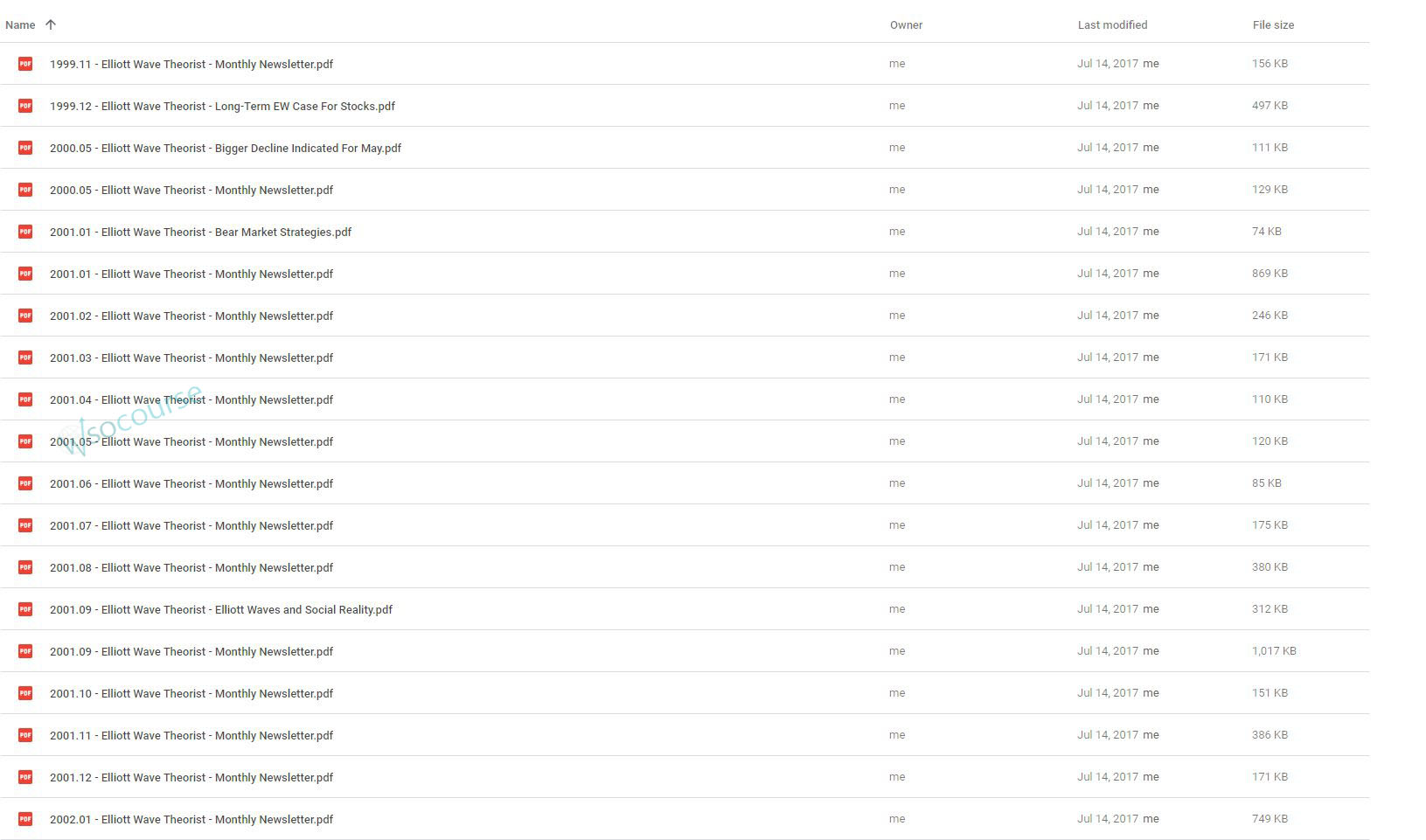
You may check content proof of “Monthly Newsletter 99-01 with Elliott Wave Theorist” below:
Exploring the Monthly Newsletter 99-01 with Elliott Wave Theorist
Introduction
In the late 90s, the Elliott Wave Theorist published a series of insightful newsletters that captured the essence of market dynamics through the lens of Elliott Wave Theory. This detailed look at the newsletters from 1999 to 2001 offers a unique glimpse into the application of this complex theory in understanding market trends.
The Basics of Elliott Wave Theory
Foundation and Principles
Elliott Wave Theory, developed by Ralph Nelson Elliott, is a method of technical analysis that looks at cyclic waves to predict stock market trends. The theory asserts that market movements are predictable in rhythmic patterns.
Application in Financial Markets
These newsletters utilized the theory to decode potential market movements, offering subscribers a strategic advantage.
Highlights from the 1999 Newsletters
Predicting the Tech Bubble
In 1999, as the tech bubble inflated, the newsletters provided crucial insights into its unsustainable nature, using Elliott Wave principles to forecast its burst.
Market Peaks and Troughs
Through meticulous analysis, the newsletters identified key turning points in the market, guiding investors on when to expect shifts.
The Year 2000: A Year of Volatility
Navigating Market Uncertainty
With the dot-com bubble’s burst imminent, the 2000 newsletters focused on strategies to handle the volatility, offering advice grounded in wave patterns.
Strategic Investment Tips
Subscribers received tips on safeguarding investments against the impending market corrections.
Insights from 2001
Post-Bubble Market Analysis
The aftermath of the bubble saw a confused market. The newsletters from 2001 helped demystify the direction of the market recovery.
Long-term Financial Planning
Advice extended beyond immediate market reactions, focusing on long-term investment strategies during uncertain times.
Methodology Behind the Analysis
Technical Analysis Techniques
The newsletters didn’t just preach theory; they demonstrated the application of various technical analysis tools to complement Elliott Wave predictions.
Case Studies
Real-time case studies provided subscribers with practical examples of how to apply theory to market activities.
Impact and Legacy
Influencing Traders and Analysts
These newsletters significantly influenced the strategies of many traders and analysts who subscribe to wave theory.
Educational Value
They also served an educational purpose, enhancing understanding of a complex theory through real-world applications.
Challenges and Criticisms
Skepticism in the Financial Community
Despite its advantages, Elliott Wave Theory—and by extension, the newsletters—faced skepticism for its perceived subjectivity in wave interpretation.
Addressing the Criticisms
The newsletters often tackled these criticisms head-on, defending the theory’s validity with empirical evidence.
Conclusion
The Monthly Newsletter 99-01 with Elliott Wave Theorist represents a critical piece of financial literature that offered timely, theory-backed insights during one of the most tumultuous periods in modern financial history. Their legacy is a testament to the enduring value of combining theory with practical market analysis.
FAQs
- What is Elliott Wave Theory?
- Elliott Wave Theory is a form of technical analysis that predicts market trends by identifying recurring wave patterns.
- How did the newsletters use Elliott Wave Theory?
- They applied the theory to analyze and predict market movements, offering strategic advice to subscribers.
- What was significant about the newsletters during the tech bubble?
- They provided foresight into the bubble’s burst, using wave patterns to predict when the market would turn.
- Can Elliott Wave Theory be applied today?
- Yes, it remains a valuable tool for technical analysts and traders looking to understand and predict market trends.
- What were some criticisms faced by the newsletters?
- Critics argued that the theory is too subjective, relying heavily on the analyst’s interpretation of wave patterns.
Be the first to review “Monthly Newsletter 99-01 with Elliott Wave Theorist”
You must be logged in to post a review.
Related products

Original price was: $895.00.$15.00Current price is: $15.00.
Original price was: $497.00.$11.00Current price is: $11.00.

Forex Trading
Original price was: $125.00.$17.00Current price is: $17.00.

Original price was: $197.00.$5.00Current price is: $5.00.
Forex Trading
The Complete Guide to Multiple Time Frame Analysis & Reading Price Action with Aiman Almansoori
Original price was: $1,399.00.$13.00Current price is: $13.00.

Forex Trading
Original price was: $499.00.$15.00Current price is: $15.00.

Original price was: $997.00.$13.00Current price is: $13.00.

Original price was: $1,200.00.$23.00Current price is: $23.00.

Original price was: $4,995.00.$15.00Current price is: $15.00.

Original price was: $997.00.$8.00Current price is: $8.00.

Original price was: $299.00.$8.00Current price is: $8.00.

Original price was: $700.00.$39.00Current price is: $39.00.

Forex Trading
Quantamentals – The Next Great Forefront Of Trading and Investing with Trading Markets
Original price was: $1,495.00.$8.00Current price is: $8.00.

Original price was: $497.00.$31.00Current price is: $31.00.

Original price was: $139.00.$23.00Current price is: $23.00.

Forex Trading
Original price was: $850.00.$23.00Current price is: $23.00.

Forex Trading
Original price was: $550.00.$5.00Current price is: $5.00.

Forex Trading
Original price was: $999.00.$15.00Current price is: $15.00.

Forex Trading
Original price was: $797.00.$10.00Current price is: $10.00.

Original price was: $310.00.$23.00Current price is: $23.00.

Reviews
There are no reviews yet.