
-
×
 Ultimate Trading Course with Dodgy's Dungeon
1 × $8.00
Ultimate Trading Course with Dodgy's Dungeon
1 × $8.00 -
×
 The Naked Eye: Raw Data Analytics with Edgar Torres - Raw Data Analytics
1 × $8.00
The Naked Eye: Raw Data Analytics with Edgar Torres - Raw Data Analytics
1 × $8.00 -
×
 The Orderflow Masterclass with PrimeTrading
1 × $17.00
The Orderflow Masterclass with PrimeTrading
1 × $17.00 -
×
 W. D Gann 's Square Of 9 Applied To Modern Markets with Sean Avidar - Hexatrade350
1 × $23.00
W. D Gann 's Square Of 9 Applied To Modern Markets with Sean Avidar - Hexatrade350
1 × $23.00 -
×
 WondaFX Signature Strategy with WondaFX
1 × $5.00
WondaFX Signature Strategy with WondaFX
1 × $5.00 -
×
 High Probability Trading Using Elliott Wave And Fibonacci Analysis withVic Patel - Forex Training Group
1 × $10.00
High Probability Trading Using Elliott Wave And Fibonacci Analysis withVic Patel - Forex Training Group
1 × $10.00 -
×
 Essentials in Quantitative Trading QT01 By HangukQuant's
1 × $23.00
Essentials in Quantitative Trading QT01 By HangukQuant's
1 × $23.00 -
×
 A Game Plan for Investing in the 21st Century with Thomas J.Dorsey
1 × $6.00
A Game Plan for Investing in the 21st Century with Thomas J.Dorsey
1 × $6.00 -
×
 The Trading Blueprint with Brad Goh - The Trading Geek
1 × $5.00
The Trading Blueprint with Brad Goh - The Trading Geek
1 × $5.00 -
×
 Matrix Spread Options Trading Course with Base Camp Trading
1 × $31.00
Matrix Spread Options Trading Course with Base Camp Trading
1 × $31.00 -
×
 ICT Prodigy Trading Course – $650K in Payouts with Alex Solignani
1 × $15.00
ICT Prodigy Trading Course – $650K in Payouts with Alex Solignani
1 × $15.00 -
×
 Crystal Ball Pack PLUS bonus Live Trade By Pat Mitchell - Trick Trades
1 × $20.00
Crystal Ball Pack PLUS bonus Live Trade By Pat Mitchell - Trick Trades
1 × $20.00 -
×
 Butterfly and Condor Workshop with Aeromir
1 × $15.00
Butterfly and Condor Workshop with Aeromir
1 × $15.00 -
×
 Best of the Best: Collars with Amy Meissner & Scott Ruble
1 × $15.00
Best of the Best: Collars with Amy Meissner & Scott Ruble
1 × $15.00 -
×
 Deep Dive Butterfly Trading Strategy Class with SJG Trades
1 × $41.00
Deep Dive Butterfly Trading Strategy Class with SJG Trades
1 × $41.00 -
×
 The A14 Weekly Option Strategy Workshop with Amy Meissner
1 × $23.00
The A14 Weekly Option Strategy Workshop with Amy Meissner
1 × $23.00 -
×
 The Prop Trading Code with Brannigan Barrett - Axia Futures
1 × $23.00
The Prop Trading Code with Brannigan Barrett - Axia Futures
1 × $23.00 -
×
 Home Run Options Trading Course with Dave Aquino - Base Camp Trading
1 × $11.00
Home Run Options Trading Course with Dave Aquino - Base Camp Trading
1 × $11.00 -
×
 A Plan to make $3k Monthly on $25k with Short Term Trades with Dan Sheridan
1 × $23.00
A Plan to make $3k Monthly on $25k with Short Term Trades with Dan Sheridan
1 × $23.00 -
×
 Advanced Spread Trading with Guy Bower - MasterClass Trader
1 × $15.00
Advanced Spread Trading with Guy Bower - MasterClass Trader
1 × $15.00 -
×
 How To Read The Market Professionally with TradeSmart
1 × $27.00
How To Read The Market Professionally with TradeSmart
1 × $27.00 -
×
 Trading Short TermSame Day Trades Sep 2023 with Dan Sheridan & Mark Fenton - Sheridan Options Mentoring
1 × $31.00
Trading Short TermSame Day Trades Sep 2023 with Dan Sheridan & Mark Fenton - Sheridan Options Mentoring
1 × $31.00 -
×
 White Phoenix’s The Smart (Money) Approach to Trading with Jayson Casper
1 × $39.00
White Phoenix’s The Smart (Money) Approach to Trading with Jayson Casper
1 × $39.00 -
×
 Bond Market Course with The Macro Compass
1 × $15.00
Bond Market Course with The Macro Compass
1 × $15.00 -
×
 The Complete Guide to Multiple Time Frame Analysis & Reading Price Action with Aiman Almansoori
1 × $13.00
The Complete Guide to Multiple Time Frame Analysis & Reading Price Action with Aiman Almansoori
1 × $13.00 -
×
 3 Hour Calendar Class With Bonus 3 Months Daily Analysis!
1 × $23.00
3 Hour Calendar Class With Bonus 3 Months Daily Analysis!
1 × $23.00 -
×
 0 DTE Options Trading Workshop with Aeromir Corporation
1 × $15.00
0 DTE Options Trading Workshop with Aeromir Corporation
1 × $15.00 -
×
 Investment Analysis and Portfolio Management with Frank Reilly
1 × $6.00
Investment Analysis and Portfolio Management with Frank Reilly
1 × $6.00
3 Technical Indicators to Help You Ride the Elliott Wave Trend with Chris Carolan
Original price was: $49.00.$6.00Current price is: $6.00.
File Size: 65.7 MB
Delivery Time: 1–12 hours
Media Type: Online Course
Content Proof: Watch Here!
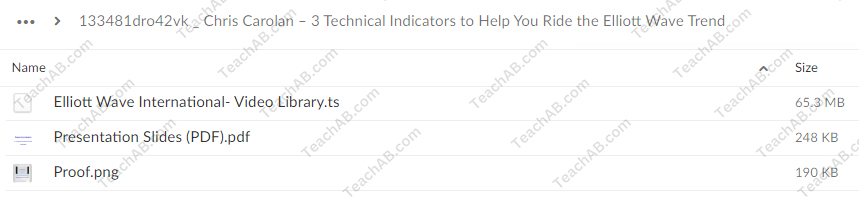
You may check content proof of “3 Technical Indicators to Help You Ride the Elliott Wave Trend with Chris Carolan” below:
3 Technical Indicators to Help You Ride the Elliott Wave Trend with Chris Carolan
Introduction to Elliott Wave Theory
Elliott Wave Theory is a powerful tool used by traders to predict market trends by identifying repeating patterns in market movements. This theory, developed by Ralph Nelson Elliott, is based on the idea that market prices unfold in specific patterns, known as waves, driven by investor psychology. Chris Carolan, an expert in Elliott Wave analysis, combines this theory with technical indicators to enhance trading strategies.
Who is Chris Carolan?
An Expert in Market Analysis
Chris Carolan is a respected figure in the field of market analysis. He is renowned for his expertise in Elliott Wave Theory and has authored several works on market trends and technical analysis. Carolan’s insights help traders navigate the complexities of the financial markets with greater precision.
Importance of Technical Indicators in Elliott Wave Trading
Enhancing Accuracy
Technical indicators provide additional confirmation of Elliott Wave patterns, enhancing the accuracy of predictions and trading decisions.
Identifying Trends and Reversals
These indicators help traders identify trends and potential reversals, making it easier to determine optimal entry and exit points.
The Role of Technical Indicators in Elliott Wave Analysis
Complementing Wave Patterns
Technical indicators complement the wave patterns by providing quantitative data, which helps in validating the patterns observed through Elliott Wave analysis.
Filtering Out Noise
They help filter out market noise, making it easier to focus on significant price movements and trends.
1. Moving Averages
What are Moving Averages?
Moving averages are statistical tools used to analyze data points by creating a series of averages of different subsets of the full data set. They help smooth out price data to identify the direction of the trend.
Types of Moving Averages
- Simple Moving Average (SMA): Calculates the average of a selected range of prices by the number of periods in that range.
- Exponential Moving Average (EMA): Gives more weight to recent prices, making it more responsive to new information.
Using Moving Averages with Elliott Waves
- Identifying Trends: Moving averages help confirm the direction of the trend.
- Support and Resistance Levels: They act as dynamic support and resistance levels, providing potential entry and exit points.
2. Relative Strength Index (RSI)
What is RSI?
The Relative Strength Index (RSI) is a momentum oscillator that measures the speed and change of price movements. It oscillates between 0 and 100, helping identify overbought or oversold conditions.
How RSI Works
- Overbought Conditions: RSI values above 70 indicate that an asset may be overbought and due for a correction.
- Oversold Conditions: RSI values below 30 suggest that an asset may be oversold and poised for a rebound.
Using RSI with Elliott Waves
- Wave Confirmation: RSI helps confirm the end of impulse waves and the beginning of corrective waves.
- Divergences: RSI divergences can signal potential reversals, aligning with Elliott Wave patterns.
3. Fibonacci Retracements
What are Fibonacci Retracements?
Fibonacci retracement levels are horizontal lines that indicate where support and resistance are likely to occur. They are based on the Fibonacci sequence, a series of numbers where each number is the sum of the two preceding ones.
Common Fibonacci Levels
- 38.2%, 50%, 61.8%: These are the most commonly used retracement levels, helping traders predict the extent of corrections during a trend.
Using Fibonacci Retracements with Elliott Waves
- Wave Analysis: Fibonacci retracements are used to identify potential reversal points within Elliott Waves.
- Entry and Exit Points: They help determine strategic entry and exit points based on anticipated market corrections.
Combining Indicators for Optimal Results
Synergy Between Indicators
Combining moving averages, RSI, and Fibonacci retracements with Elliott Wave analysis creates a more robust trading strategy. Each indicator provides unique insights, making the overall analysis more comprehensive.
Practical Application
- Trend Confirmation: Use moving averages to confirm the overall trend direction.
- Momentum Analysis: Apply RSI to gauge the strength of the trend and identify potential reversals.
- Correction Levels: Utilize Fibonacci retracements to pinpoint potential correction levels and entry points.
Case Studies and Real-World Examples
Successful Trades
Chris Carolan often shares case studies demonstrating successful trades using these combined methods. These examples illustrate the effectiveness of integrating technical indicators with Elliott Wave analysis.
Learning from Mistakes
Analyzing past mistakes and understanding what went wrong provides valuable lessons for future trades.
Educational Resources
Books and Articles
Chris Carolan has authored numerous resources that delve deeper into Elliott Wave Theory and its practical applications.
Online Courses and Webinars
Many online courses and webinars are available for traders looking to enhance their skills in Elliott Wave analysis and the use of technical indicators.
Conclusion
Combining 3 Technical Indicators to Help You Ride the Elliott Wave Trend with Chris Carolan offers traders a powerful toolkit for enhancing their market analysis and trading strategies. By mastering moving averages, RSI, and Fibonacci retracements, and integrating them with Elliott Wave Theory, traders can achieve greater accuracy and consistency in their trades.
Frequently Asked Questions
1. What is Elliott Wave Theory?
Elliott Wave Theory is a method of technical analysis that identifies patterns in market prices to predict future movements.
2. Who is Chris Carolan?
Chris Carolan is a renowned market analyst and expert in Elliott Wave Theory, known for his educational contributions and market insights.
3. How do moving averages help in trading?
Moving averages smooth out price data, helping to identify trends and act as dynamic support and resistance levels.
4. What does RSI indicate in trading?
RSI measures the speed and change of price movements, identifying overbought or oversold conditions that can signal potential reversals.
5. How are Fibonacci retracements used in trading?
Fibonacci retracements help identify potential support and resistance levels, aiding in determining strategic entry and exit points during market corrections.
Be the first to review “3 Technical Indicators to Help You Ride the Elliott Wave Trend with Chris Carolan”
You must be logged in to post a review.
Related products
Original price was: $895.00.$15.00Current price is: $15.00.

Original price was: $997.00.$13.00Current price is: $13.00.

Original price was: $1,849.00.$15.00Current price is: $15.00.
Forex Trading
The Complete Guide to Multiple Time Frame Analysis & Reading Price Action with Aiman Almansoori
Original price was: $1,399.00.$13.00Current price is: $13.00.
Original price was: $997.00.$8.00Current price is: $8.00.
Original price was: $310.00.$23.00Current price is: $23.00.
Forex Trading
Original price was: $125.00.$17.00Current price is: $17.00.

Forex Trading
Original price was: $500.00.$5.00Current price is: $5.00.

Original price was: $4,995.00.$15.00Current price is: $15.00.
Original price was: $649.00.$20.00Current price is: $20.00.
Original price was: $2,120.00.$15.00Current price is: $15.00.

Forex Trading
Original price was: $1,098.00.$39.00Current price is: $39.00.
Original price was: $695.00.$41.00Current price is: $41.00.
Original price was: $799.00.$15.00Current price is: $15.00.

Forex Trading
Original price was: $2,997.00.$23.00Current price is: $23.00.
Forex Trading
Original price was: $799.00.$15.00Current price is: $15.00.

Original price was: $197.00.$5.00Current price is: $5.00.

Forex Trading
Original price was: $249.00.$15.00Current price is: $15.00.
Forex Trading
Original price was: $499.00.$15.00Current price is: $15.00.

Original price was: $1,800.00.$54.00Current price is: $54.00.
Reviews
There are no reviews yet.